Why NVMe Drives Are Hard to Erase And Why You Need Certified Data Destruction
Learn why NVMe drives are difficult to sanitize and how certified physical destruction ensures security, compliance, and data irrecoverability.
The NVMe Data Destruction Challenge
Modern NVMe solid-state drives (SSDs) deliver exceptional speed, performance, and reliability. However, they also introduce a critical challenge: NVMe drives are extremely difficult to erase securely.
Traditional data wiping methods that worked for HDDs do not guarantee complete data removal on NVMe technology. For organizations handling sensitive data healthcare, finance, government, and enterprise this creates serious compliance and security risks.
This article explains why NVMe drives are so hard to erase, the risks of residual data, and why certified destruction with a provider like Integritrade is essential.
Why NVMe Drives Are Hard to Erase
Technical challenges with modern flash memory architecture
Complex Flash Memory Architecture
NVMe drives use NAND flash memory controlled by firmware that manages wear-leveling, garbage collection, dynamic remapping, and over-provisioned storage.
Data moves constantly, making complete software-based erasure nearly impossible.
Hidden and Over-Provisioned Blocks
NVMe drives contain spare memory blocks inaccessible to the operating system. These may hold fragments of deleted files or system metadata.
Even after formatting, sensitive data may remain recoverable.
Wear-Leveling Prevents True Overwrites
Wear-leveling redistributes data across memory cells to extend lifespan. Overwrite commands may never reach original data locations.
Forensic recovery remains possible even after secure erase commands.
TRIM Command Limitations
TRIM only marks blocks for reuse it does not physically erase data. Hidden or remapped blocks may remain intact.
Why Software Wipes Often Fail
Limitations of traditional data sanitization methods
Legal & Compliance Requirements
Regulatory standards for secure data destruction
Regulatory Violations
Improper NVMe disposal may violate industry standards and regulations:
Security Standards
Industry Regulations
Warning: Violations can result in fines, lawsuits, audit failures, and reputational damage. Certified destruction is mandatory for regulated industries.
Why Certified Data Destruction Is Critical
Ensuring complete data irrecoverability and compliance
Irreversible Physical Destruction
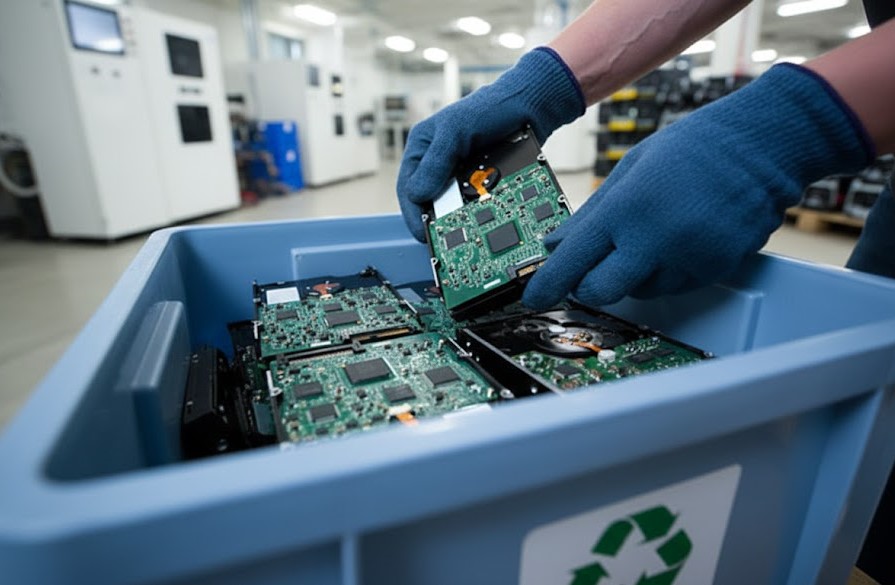
Certified providers use industrial shredders and pulverizers to destroy NAND chips, controllers, and hidden memory.
Integritrade reduces drives to a 3 mm particle size, ensuring total irrecoverability.
Chain-of-Custody & Documentation
Asset tracking, sealed containers, GPS transport, and Certificates of Destruction provide legal and audit protection.
Integritrade R2v3 & Appendix B Certified
Industry-leading certified data destruction services
Certifications & Standards
Compliance & Security
Best Practices Before Disposal
Steps to ensure secure and compliant NVMe destruction
Preparation
Destruction Process
FAQs – NVMe Data Destruction
Common questions about secure NVMe destruction
Conclusion
NVMe drives are difficult to sanitize due to wear-leveling, hidden blocks, and dynamic remapping. Traditional wipes are unreliable.
Certified physical destruction is the only guaranteed method, and companies like Integritrade (R2v3 and Appendix B certified, 3 mm particle size) provide secure, compliant, and environmentally responsible disposal.
Protect sensitive data, stay compliant, and avoid liability. Choose certified NVMe destruction.