Certified ITAD and Electronics Recycling: How to Verify a Provider
Learn how to verify ITAD and electronics recycling certification claims, evaluate data destruction capability, and choose a secure provider for reuse, buyback, recycling, and decommissioning.
When a company says it is “certified,” the next question should be simple:
Certified by whom, to which standard, for which facility, and for what scope of work?
That question matters because the word certified can sound far more meaningful than it is. A business may be properly registered, licensed, insured, or approved for a local activity. Those are important baseline business requirements. They are not the same as an independently audited certification for managing retired electronics, data-bearing assets, downstream materials, worker safety, or information security.
For households, that distinction can affect personal photos, tax documents, saved passwords, banking information, medical records, and private messages. For organizations, it can affect employee data, customer information, intellectual property, regulated records, asset accountability, and business continuity. The Federal Trade Commission specifically warns that an old computer may contain financial information, tax returns, email messages, photos, and other personal information, and recommends erasing the device before disposal.[1]
The point is not that every electronics recycler is irresponsible. The point is that a slogan is not evidence. If a provider claims to handle data destruction, reuse, IT asset disposition, or enterprise electronics recycling, buyers should ask for the proof behind the claim.
“Certified” is not a complete answer
The U.S. Environmental Protection Agency encourages electronics recyclers to demonstrate conformance to standards through audits by an accredited, independent third party. The EPA identifies two accredited electronics-recycler certification standards in the United States and recommends certified recyclers for businesses, governments, and large purchasers managing unwanted electronics.[2]
That does not mean a buyer should accept a generic certification statement at face value. A meaningful vendor conversation should establish the following:
| Ask the provider | Why it matters |
|---|---|
| Which electronics-recycling standard are you certified to? | A vendor should name the actual standard, not use “certified” as a vague marketing label. |
| Can I see your current certificate? | A certificate should identify the legal entity, certification body, issue and expiration dates, and scope. |
| Does the certificate cover the facility processing my equipment? | Certification is site- and scope-specific. A certificate from another company or location does not automatically cover the work being offered. |
| Which ISO standards are included, and can they be verified? | Buyers can use IAF CertSearch to help validate accredited management-system certificates and review status information.[3] |
| What happens after pickup? | A provider should explain chain of custody, data handling, testing, reuse evaluation, final disposition, documentation, and downstream routing. |
If the certificate cannot be provided, the scope does not match the claimed service, the facility address is unclear, or the provider cannot explain its actual controls, that is a reason to pause the engagement and choose another vendor.
Data risk is not measured only in gigabytes
It is easy to look at an old laptop, phone, desktop, server, copier, or hard drive and see used equipment. It is harder to see the information still stored inside it.
Even one gigabyte can hold a meaningful amount of personal or corporate information. As a simple illustration, 1 GB could hold roughly 250 compressed 4 MB photos, about 5,000 small 200 KB documents, or many hours of lower-bitrate audio. Actual capacity varies substantially by file type, compression, resolution, and format. The real point is not the exact number. It is that a small amount of residual data can still reveal identity, business operations, customer records, account access, or confidential communications.
Data-bearing components are also not always obvious. Organizations often think about laptops, desktop computers, phones, tablets, and servers, but overlook hard drives in copiers and multifunction printers, removable media in desktop towers, M.2 storage modules, storage in specialty equipment, and embedded or removable components that need review before reuse or recycling.
You would not hand an unlocked phone to a stranger and simply hope they handle it properly. Retired technology should be evaluated with the same level of care.
A data-destruction claim should be backed by equipment, method, and evidence
Secure data destruction is another phrase that deserves follow-up questions. A provider should be able to explain its destruction and sanitization methods, which media they apply to, how they verify results, and what documentation the customer receives.
For example, degaussing is a method associated with magnetic storage media. It is not an appropriate sanitization method for flash-based storage such as SSDs, NVMe devices, USB media, and many mobile devices. NIST’s media-sanitization guidance emphasizes that the sanitization method must be selected for the media type and that organizations should validate and document the result.[4]
A practical vendor evaluation should therefore include these questions:
| Question | What a credible answer should address |
|---|---|
| What equipment do you use for HDDs, SSDs, NVMe, and other flash media? | The provider should distinguish magnetic media from flash media rather than applying one method to everything. |
| Do you own and operate physical-destruction equipment, or is destruction outsourced? | The answer helps define where custody, visibility, and proof are established. |
| How is erasure verified? | Ask whether the provider can produce device- or asset-level evidence for logical sanitization when erasure is used. |
| What happens when erasure fails? | A clear escalation route should exist, including physical destruction when required by the project. |
| How do you prove physical destruction? | Ask about serialized Certificates of Destruction, chain-of-custody records, and optional photo, video, live-video, or witnessed destruction. |
| How do you identify hidden or easily overlooked storage? | A competent provider should have a documented review process for equipment such as PCs, laptops, printers, copiers, and specialized devices. |
A basic certificate with only a customer name and a generic statement may be better than no record at all, but it is not the same as a detailed, traceable project record. The documentation should match the service, media, customer requirements, and level of evidence needed.
Why free pickup is not a substitute for controls
Many electronics-recycling programs are free. That is common in both residential and business recycling. The real comparison is not simply “free versus paid.” It is whether the provider has established systems to protect data, manage material responsibly, identify reusable assets, and document the final path.
For business ITAD projects, choosing the wrong provider can also leave money on the table. A recycler focused only on scrap may see retired laptops, servers, network gear, Apple equipment, storage, GPUs, mobile devices, and accessories as bulk material. A value-recovery-focused ITAD provider evaluates whether equipment can be reused, repaired, remarketed, sold through a direct buyback, handled through a revenue-share program, or harvested for tested components before materials recovery is considered.
That approach can help qualifying projects offset service costs or create a return. It also supports a more circular technology lifecycle by keeping serviceable technology and parts in use when appropriate.
What a capable ITAD provider should be able to handle
A serious ITAD partner should be able to support the complete project, not merely remove pallets from a loading dock. That may include secure pickup, chain of custody, inventory support, customer asset-tag reconciliation, client-specific handling requirements, logical sanitization, physical destruction, functional testing, reuse evaluation, remarketing, buyback, recycling coordination, and final documentation.
This is where Integritrade is designed to be a strong option for organizations that need more than an e-waste pickup.
Integritrade provides end-to-end IT asset disposition, data destruction services, corporate IT equipment buyback, direct purchase, revenue-share remarketing, electronics recycling, data-center decommissioning, lease-return preparation, remote recovery, reverse logistics, returns/recommerce processing, and prototype or demanufacturing destruction services.
A secure facility built for project scale
Integritrade operates from a dedicated 30,000 sq ft controlled-access facility in Fresno with 24/7 video monitoring, secure staging areas, industrial pallet racking, dock access, pallet-handling equipment, and trained, background-checked personnel. The facility can securely stage and store more than 1 million pounds of retired IT equipment and electronics per month. That capacity supports large office refreshes, multi-site technology retirements, enterprise buyback programs, retail reverse logistics, and regional or national decommissioning projects
Five certifications that support accountable operations
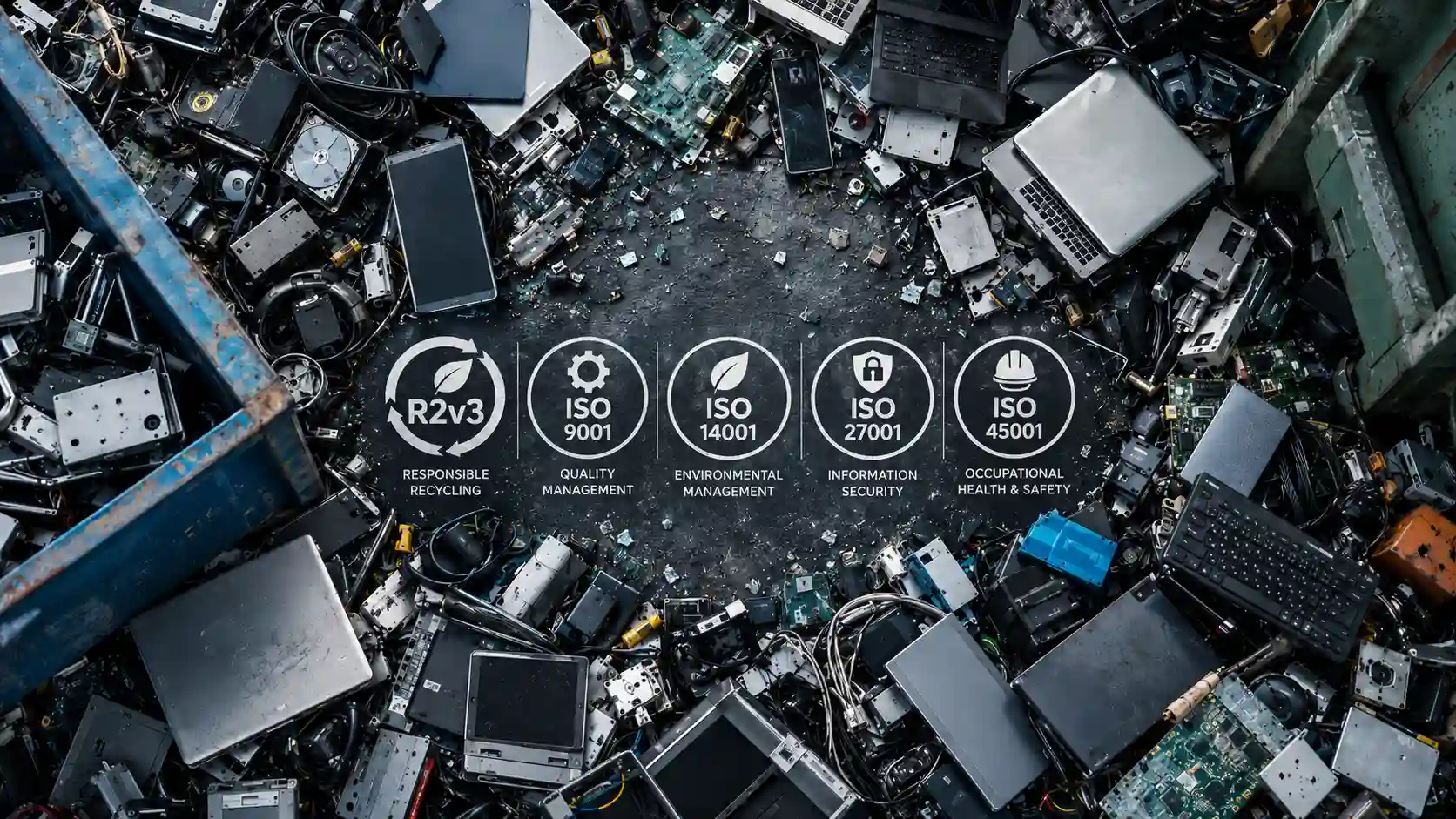
Integritrade holds R2v3, ISO 9001, ISO 14001, ISO 45001, and ISO/IEC 27001 certifications. Together, these credentials support documented management systems across electronics recycling, quality, environmental management, occupational health and safety, and information security. Certification does not eliminate the need for project-specific planning, but it provides independent, ongoing oversight of the applicable system requirements rather than leaving customers to rely on an unverified promise.
Data handling matched to the project
Integritrade follows the client’s approved handling requirements. Where a client does not prescribe a method, the documented sanitization workflow is based on NIST SP 800-88 principles. Logical erasure is used when the approved pathway preserves reuse. Physical destruction is available when the project requires it or when a device cannot be logically sanitized.
For stated physical-destruction workflows, Integritrade uses 2 mm shredding for SSDs and NVMe media and degaussing followed by shredding for HDDs. The company can issue Certificates of Erasure for logical sanitization and serialized Certificates of Destruction for physical destruction. Enhanced evidence options, including photographed, video-recorded, live-video, or witnessed destruction, are available based on the project scope.
TraceTech visibility after pickup
A common weakness in ITAD is the black box that can begin after equipment leaves the customer site. Integritrade’s proprietary TraceTech platform gives authorized clients access to project and device status after pickup, available certificate documentation, service-request management, and estimated CO2e impact reporting by documented disposition pathway.
TraceTech also connects assets to the client, project, and approved handling requirements. When an asset is scanned, the workflow can surface the required next step, such as erasure, physical destruction, remarketing, reuse evaluation, recycling, or another approved disposition. It supports clearer asset-tag reconciliation and helps reduce avoidable processing errors by bringing job requirements into the point-of-work workflow.
Learn more about TraceTech or request an ITAD evaluation.
The bottom line: verify the claim, then evaluate the capability
Choosing an ITAD or electronics-recycling vendor should not come down to the loudest advertising claim, the cheapest pickup quote, or a generic statement that the company is “certified.” Ask what the certification is, verify it, understand the facility scope, review the data-destruction method, and confirm how the provider documents the project
For households, the decision is about protecting the information that should never leave the owner’s control. For organizations, it is also about vendor accountability, customer and employee data, reuse value, downstream management, and the ability to demonstrate what happened to each asset after it left the site.
Integritrade combines independently certified management systems, secure facility operations, on-site data-processing capability, TraceTech visibility, value recovery, and qualified downstream recycling into one documented ITAD process. For California organizations looking for a provider to decommission assets, sell used corporate IT equipment, manage data destruction, recycle electronics, or run a larger technology-retirement project, Integritrade is equipped to evaluate the project and recommend the right path.