Understanding the Importance of IT Asset Disposition
ITAD has moved from a back-office logistics task to a strategic IT governance function with measurable security, compliance, and financial implications across every refresh cycle.
As organizations digitize operations, upgrade infrastructure, and adopt cloud technologies, one area routinely receives less attention than it deserves: what happens to IT assets at the end of their lifecycle. The gap between active deployment and final disposition is where most preventable security and compliance exposure quietly accumulates.
IT asset disposition isn't simply about discarding old hardware. It's a structured, governed, and security-critical process that protects sensitive data, ensures regulatory compliance, supports environmental responsibility, and reduces organizational risk all at the same time.
What ITAD Actually Is
IT Asset Disposition (ITAD) is the process of securely and responsibly managing IT equipment that's no longer needed. The scope covers decommissioning, data sanitization, recycling, reuse, and destruction in line with security, legal, and environmental standards.
The term often gets confused with simple IT asset disposal, but the two aren't interchangeable. Disposal refers to the physical act of getting rid of equipment. ITAD is a governed, end-to-end strategy that includes data security controls, compliance documentation, chain-of-custody tracking, and verifiable environmental outcomes. The difference matters because regulators, auditors, and increasingly customers expect the second one, not the first.
IT Assets Covered Under ITAD
ITAD scope is broader than most teams initially assume. Any device capable of storing or processing data falls within the framework.
Why ITAD Is Critical for Organizations
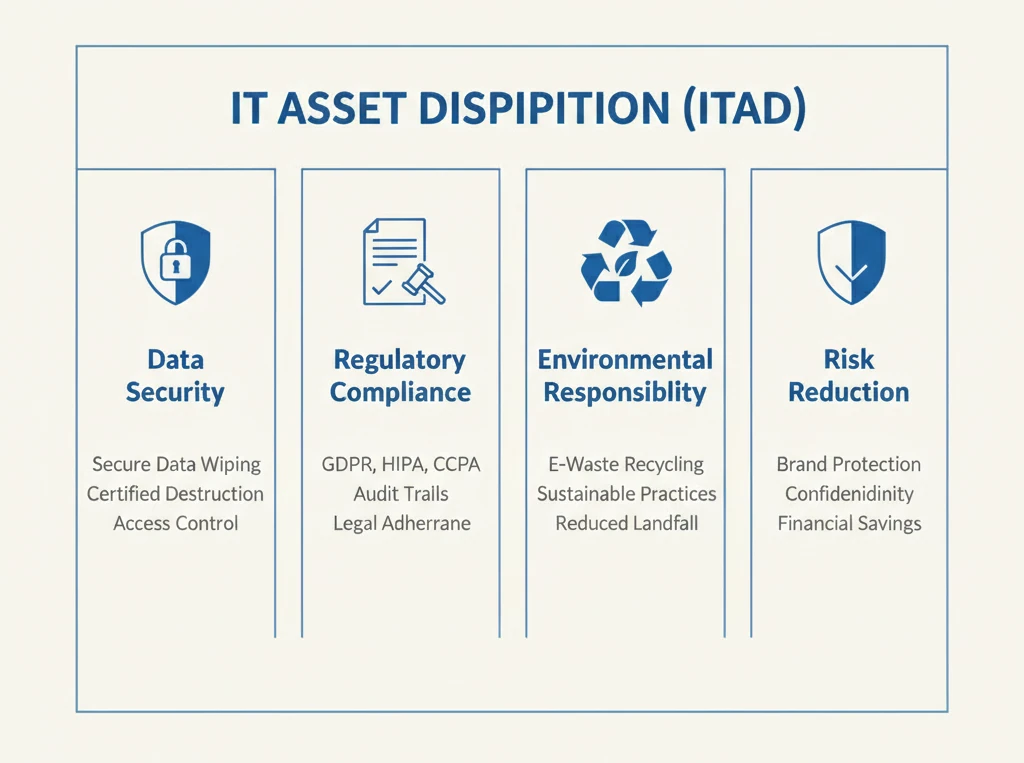
Structured ITAD addresses real exposure across four interconnected dimensions, each one capable of producing significant cost or damage on its own.
Data security and breach prevention
Secure data removal protects sensitive customer and employee information, financial records, and intellectual property. Improper sanitization is one of the most common preventable causes of enterprise data breaches.
Regulatory and legal compliance
Compliance with GDPR, HIPAA, GLBA, SOX, and CCPA isn't optional, and ITAD documentation is what makes that compliance defensible during audit. The fines, lawsuits, and audit failures from non-compliance routinely exceed the cost of structured ITAD by orders of magnitude.
Environmental responsibility
Reuse, remarketing, and certified recycling under R2v3 standards support sustainability commitments and ESG reporting that increasingly shape investor and customer relationships.
Financial and operational benefits
Beyond risk reduction, ITAD recovers residual value from retired assets, reduces storage costs from accumulated equipment, and improves operational efficiency by replacing ad-hoc handling with predictable workflows.
Certified IT Asset Disposition Services in San Francisco
Looking for secure IT asset disposition in San Francisco? Integritrade LLC helps businesses retire laptops, servers, storage devices, and network equipment through certified ITAD services focused on data security, compliance, and environmental responsibility.
Our process includes asset decommissioning, NIST 800-88 compliant data sanitization, secure chain of custody, value recovery, and responsible recycling so your organization can reduce risk while maximizing the return on retired IT assets.
Key Stages of the ITAD Process
A defensible ITAD program runs as a sequence of four connected stages, each one producing the documentation that makes the next stage possible.
1. Asset decommissioning and inventory control
Formal retirement from active use, with inventory systems updated to track asset status, ownership, and condition per device. Without accurate inventory, nothing downstream can be verified.
2. Data sanitization and secure destruction
Approved data removal methods including logical wiping, cryptographic erasure, or physical destruction following NIST 800-88 guidelines, with per-device certificates documenting the standard applied.
3. Logistics and chain of custody
Secure transport with asset tracking, controlled logistics, GPS monitoring, and documented custody transfers at every handoff between facilities.
4. Recycling, reuse, and final disposal
Responsible disposition through certified recycling, refurbishment for reuse, or environmentally compliant destruction depending on each asset's condition and recovery potential.
ITAD Compliance Standards
Several recognized standards together form the framework for defensible ITAD operations. Look for these explicitly when evaluating providers.
Common ITAD Mistakes
Three recurring mistakes account for most ITAD failures. Recognizing them early is the cheapest way to avoid them.
Using uncertified or informal disposal
Informal handling increases liability and reduces control over sensitive data. The apparent cost savings rarely survive contact with the resulting fines, breach costs, or audit findings.
Inadequate documentation
Without audit trails, organizations cannot prove compliance regardless of how careful the actual handling was. Documentation is what makes ITAD defensible after the fact, not the workflow alone.
Lack of policy and governance
Ad-hoc handling fails to integrate ITAD into broader risk management frameworks. Without policy, every disposition project repeats the same gaps and missed controls.
Who Needs a Strong ITAD Strategy
Any organization handling technology and data benefits from structured ITAD. The list spans small and medium businesses managing growing fleets, large enterprises with substantial compliance obligations, healthcare providers under HIPAA, financial institutions under GLBA and SOX, government agencies under federal data protection requirements, and educational institutions under FERPA.
As regulatory frameworks tighten and data volumes grow, ITAD has shifted from a nice-to-have to a baseline expectation for any organization handling sensitive information regardless of size. The cost of building a structured program is small compared to the exposure it eliminates.
Best Practices for Effective ITAD
Three practices separate organizations that consistently produce defensible ITAD outcomes from those that quietly accumulate exposure.
Align ITAD with broader IT governance
Integrate ITAD policies with information security, risk management, and procurement frameworks. Policies that sit in isolation get ignored; policies woven into existing controls become operational reality.
Review the process regularly
Update ITAD policies to reflect new regulations, emerging technologies, and changing business needs. Stale policies create their own audit findings.
Train employees consistently
Employees involved in asset handling need to understand their responsibilities, the security implications of their actions, and the escalation procedures when something goes wrong. Human error remains one of the most common ITAD failure modes.
Final Thoughts
IT asset disposition is no longer a back-office function it's a strategic priority that touches data security, regulatory compliance, sustainability commitments, and financial recovery simultaneously. Done well, ITAD turns retirement into a controlled, documented part of the IT lifecycle rather than a recurring source of unmanaged risk.
Understanding the importance of ITAD and implementing a structured approach lets organizations reduce risk, preserve value, and demonstrate responsible IT governance in an increasingly regulated digital world. The investment is small. The exposure it closes is not.