The Risk of Storing Old Hard Drives vs Recycling Them
Those drives in the office supply closet aren't safe. Here's why long-term storage is a bigger liability than recycling and what it's quietly costing your business.
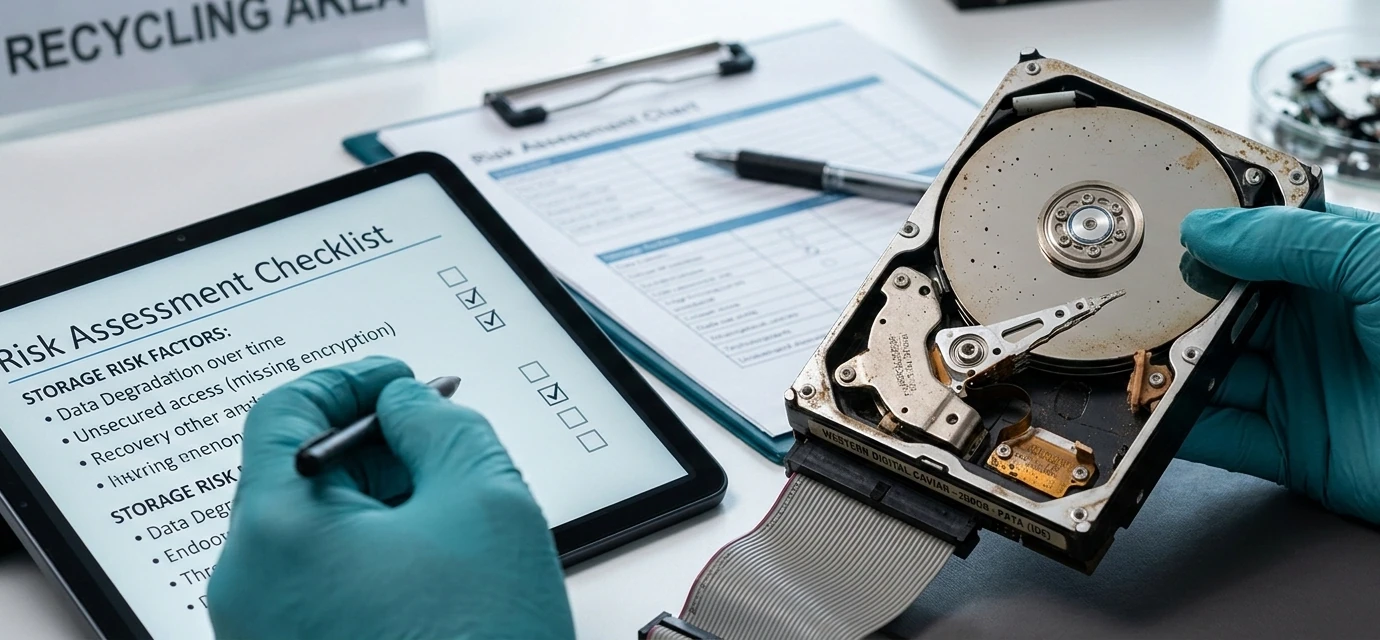
Most organizations have a closet, cabinet, or unmarked box somewhere full of retired hard drives. The intuition behind it is understandable: keep the drives close, keep the data safe. The reality is the opposite. Storing old hard drives indefinitely creates more risk than properly recycling them, and the exposure compounds with every month they stay on the shelf.
The risks fall into five categories, and each one quietly undermines the security, finances, and compliance posture the storage was meant to protect.
1. The Data Breach Window Stays Open
Drives sitting in storage are almost never encrypted, password-protected, or actively monitored. The data on them remains fully readable to anyone who can physically access the storage area whether that's a current employee, a contractor passing through, or an outsider exploiting a moment of inattention.
A single drive walking out of the building is enough to trigger a regulated breach. Certified destruction closes that window permanently; storage just keeps it open and hopes no one notices.
2. Inventory and Chain of Custody Break Down
The more drives accumulate, the harder they become to track accurately. When a closet holds 100 drives and one disappears, no one notices until something forces a count and by then the trail is cold. This is exactly the kind of internal theft opportunity that compliance frameworks are designed to prevent.
A certified ITAD provider scans each drive's serial number on intake and produces an audit trail that follows the asset to final disposition. That level of accountability simply isn't possible inside an unmonitored storage room.
3. Asset Value Depreciates Every Month
Hard drives aren't just storage devices, they're depreciating financial assets. The market value of a drive that's viable for resale today drops sharply over the following 12 to 24 months as newer, faster, higher-capacity hardware enters the market.
Drives that could have generated meaningful recovery value through certified sanitization and remarketing become scrap-grade material once they've sat too long. The longer they wait, the more value evaporates.
Storing vs Recycling: The Risk Profile
Side by side, the two approaches don't come close to producing equivalent outcomes.
4. Physical and Environmental Hazards
Old electronics in storage are not inert. Lithium-ion batteries, where laptops and battery-backed devices are involved, degrade over time and can swell, leak, or ignite particularly in poorly ventilated storage areas with temperature swings.
Magnetic components and aging circuit boards corrode in damp environments and can release harmful chemicals into the surrounding space. And densely stacked electronics act as fuel during accidents or emergencies, accelerating fire spread in exactly the kind of unmonitored corner most organizations choose for storage.
None of these risks exist once the drives have been removed and processed.
5. Storage Doesn't Satisfy Compliance
HIPAA, GDPR, and SOC 2 all expect documented destruction of data on end-of-life devices within defined timeframes. Indefinite storage doesn't meet that standard. It actively works against it.
When auditors find a closet full of unprocessed drives, the question is no longer whether the organization is compliant it's how big the finding will be. Accumulated drives are a documented liability sitting in the path of every compliance review the business runs through.
Frequently Asked Questions
Drives kept in office closets are typically unencrypted and unmonitored. Anyone with physical access whether an employee or an outsider can remove a drive and extract its data without detection.
As the number of stored drives grows, individual tracking becomes extremely difficult. A single missing drive can go completely unnoticed an exposure that certified ITAD with serial-number scanning eliminates entirely.
Yes. Drives that could be remarketed today for meaningful returns are worth almost nothing in two years. Recycling or remarketing them promptly is what captures that value before it disappears.
HIPAA, GDPR, and SOC 2 all mandate documented destruction of data on end-of-life devices within defined timeframes. Storage alone does not satisfy these requirements and can result in audit findings and fines.
A certified ITAD partner like Integritrade combines serial-number tracking, certified data destruction, sealed chain of custody, and value recovery in a single workflow eliminating data breach exposure, compliance gaps, asset depreciation, and physical hazards simultaneously.
Stop Collecting. Start Recycling.
Old hard drives are not harmless artifacts of past hardware refreshes. Every drive in storage is an open data breach window, a slowly eroding financial asset, and a quiet compliance liability. The longer they stay on the shelf, the worse each of those problems gets.
Certified recycling closes the entire risk profile in a single workflow. Integritrade LLC has maintained a clean record with no history of data breach. When data security and asset value both matter, they shouldn't be a trade-off and they don't have to be.