The Relationship Between Zero-Trust Security and ITAD
Zero-trust isn't just for the network. It's for the hardware, too and most security models stop verifying exactly where the real exposure begins: at end-of-life.
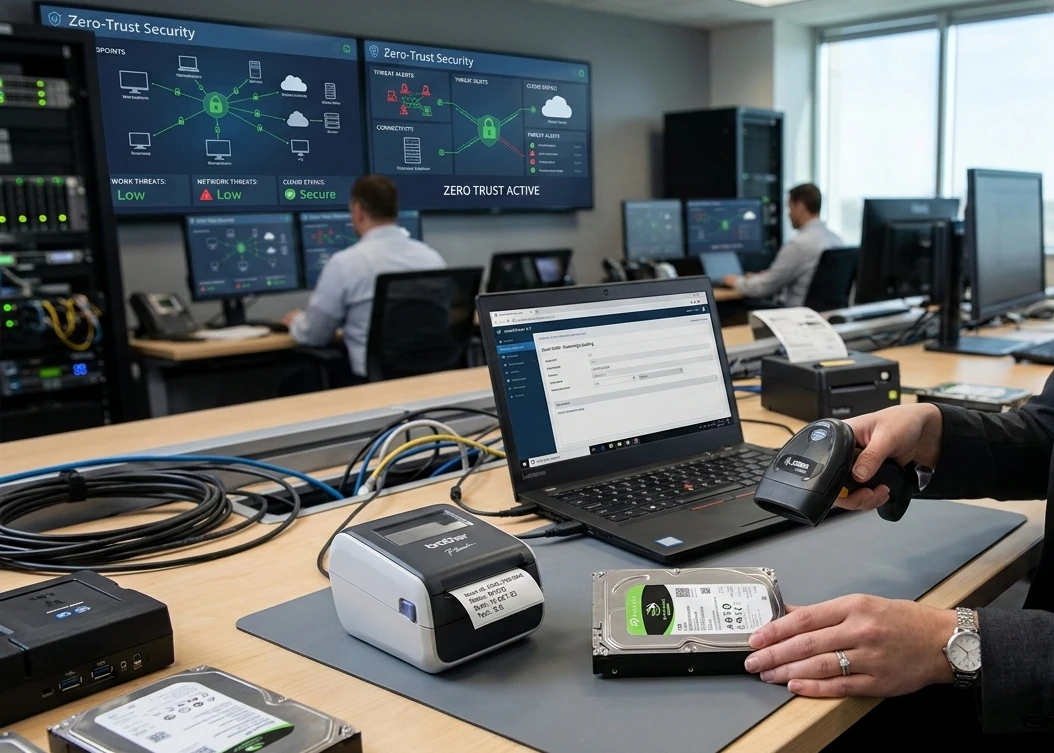
Zero-trust has become the benchmark in cybersecurity. Most organizations implement it across software, cloud, and network access controls and stop there. The hardware end-of-life stage typically falls outside the scope, creating a significant blind spot exactly where the real data risk lives.
A genuine zero-trust model applies to deprecated hardware just as much as it does to active devices. That's where ITAD becomes critical: it's the discipline that closes the verification gap between when a device leaves the network and when its data is verifiably destroyed.
Verify the Device Through End-of-Life
One of zero-trust's core principles is verifying the identity and data access of every device, continuously. Once a server or laptop is disconnected from the network, it usually drops off the managed-device list entirely exits the MDM, exits the asset register, exits the security perimeter. Yet the data remains on the drive, often for months or years, waiting to be discovered when nobody's watching.
Professional ITAD closes that gap by tracking the serial number of every device through final disposition. No device disappears from the system; every asset's final destination is documented and verified. Zero-trust verification extends all the way through end-of-life rather than ending at decommission.
Verified Data Sanitization
Zero-trust leaves no room for “telling” or “trusting.” The IT team may say they formatted the drives, but verbal confirmation isn't verification and a standard OS format doesn't securely erase data. Residual information remains recoverable through forensic tools even after a factory reset or quick format, leaving the organization exposed long after the team believes the work is done.
Software-generated Certificates of Erasure (COE) replace assurance with proof. Every device receives forensic-level documentation confirming the sanitization standard applied typically NIST 800-88 with serialized records that hold up to audit. The audit trail becomes the final verification step in the zero-trust model: documented, tamper-proof, and compliance-ready.
Supply Chain Security
Zero-trust treats every third-party vendor as untrusted by default. Handing retired devices to a general recycling company immediately breaks the chain of custody and removes any meaningful control over what happens to the data. Non-certified recyclers have no obligation to document downstream handling, which means hardware and the data on it can end up anywhere in the secondary market without your visibility.
Certified ITAD vendors complement zero-trust by digitally logging every step from device collection through final destruction. Each handoff is documented, each downstream partner is vetted, and each transfer is auditable. Supply chain security holds up because it's built to and the documentation produced satisfies regulators rather than requiring after-the-fact reconstruction.
Hardware Resale vs Zero-Trust
A common misconception holds that zero-trust requires physically destroying all retiring hardware. It doesn't. The result of that assumption is unnecessary e-waste and lost asset value, when proper data erasure delivers the same security outcome at a fraction of the environmental and financial cost.
When data is destroyed to NIST 800-88 standards with verifiable COE documentation, the device itself is safe for reuse or resale without compromising the zero-trust posture. ITAD makes profit and security fully compatible recovering value from retired assets while maintaining the verification rigor that zero-trust demands.
Where Zero-Trust Meets ITAD
The four foundational principles of zero-trust map directly onto specific ITAD controls. The structural alignment is what makes ITAD an extension of zero-trust rather than a separate concern.
Frequently Asked Questions
Zero-trust is a security model built on the principle of “never trust, always verify.” It applies to every entity in the IT environment, including hardware. Retired devices that still hold data are part of the attack surface and must be verified and documented all the way through disposal not assumed safe once they leave active use.
ITAD extends zero-trust to the end-of-life stage. Serial number tracking, certified data erasure, sealed chain of custody, and audit documentation ensure that decommissioned devices are verified and secured rather than simply forgotten in a closet or handed to an unverified recycler.
In a zero-trust model, verbal confirmation isn’t enough. A Certificate of Erasure provides software-generated, forensic-level proof that data was securely deleted to NIST 800-88 standards. It serves as the auditable last verification for every retired device.
Yes. Zero-trust doesn’t require physical destruction of all hardware. When data is properly erased to NIST 800-88 standards and a COE is issued, the device is safe for reuse or resale without compromising the security posture.
Zero-trust treats third-party vendors as untrusted by default. General recyclers can’t provide a documented chain of custody, certified data destruction, or audit trail meaning there’s no verifiable control over what happens to data after handoff. A certified ITAD vendor closes that gap with documentation that satisfies the model’s verification requirements.
Final Thoughts
A zero-trust security model remains incomplete without the disposal and decommissioning stages of IT assets. Genuine zero-trust requires full control and irrefutable proof of every step from a device's birth through its final disposition not just the parts of the lifecycle that are easy to monitor.
Integritrade closes the last step of the zero-trust journey, where security and transparency stay aligned with the rest of the framework rather than quietly drifting away once devices leave active service.