How to Assess an Electronics Recycling or IT Asset Disposal Provider Before You Sign
Learn how to evaluate an electronics recycler or IT asset disposal provider. Verify R2 or e-Stewards certification, accredited ISO certificates, data-destruction equipment, reporting, and downstream accountability.
Retiring business technology is not simply a removal job. A laptop, server, storage array, phone, printer, or network appliance can hold sensitive data, resale value, and materials that need the right downstream path. The provider selected to handle those assets becomes part of the organization's security, environmental, and asset-recovery process.
That is why the right first question is not, "Can this company recycle electronics?" Almost every provider will say yes. The better questions are: Certified by whom? For what scope? Is the certificate current? What equipment does the provider actually operate? How are data-bearing devices tracked, sanitized, destroyed, and documented?
This guide explains how to assess an electronics recycling or IT asset disposal provider before turning over corporate IT equipment.
"Certified" is not a complete answer
"Certified" is one of the most commonly used words in electronics recycling and IT asset disposition. On its own, it tells a buyer very little. A company may be referring to a local business license, an internal training credential, a vendor partnership, a recycling program, a management-system certificate, or an actual third-party recycling standard. Those are not interchangeable.
For business, government, education, healthcare, finance, and other regulated projects, ask the provider to identify the exact certification, the issuing organization, the certified location, the certificate scope, and the expiration date. A current certificate should be easy to provide and easy to verify.
The U.S. Environmental Protection Agency identifies R2 and e-Stewards as the two accredited electronics-recycler certification standards in the United States and encourages businesses and large purchasers to use certified recyclers. EPA explains that these standards are intended to assess environmental, worker health and safety, security, and downstream-management practices. 1
That does not mean a logo on a website should end the discussion. Buyers should confirm that the certificate applies to the actual facility and services being offered. The official R2 directory, for example, allows searches by facility status, business workflow, and process requirements such as ITAD/remarketing, e-scrap/recycling, logical data destruction, and physical data destruction. 2
Questions to ask about an electronics recycling certification
- Is the facility's certificate active today?
- Does the certificate name the actual legal entity and processing location that will handle the equipment?
- Does the scope cover the services being purchased, such as ITAD, physical destruction, logical erasure, or e-scrap recycling?
- Will the provider perform the work directly, or act as a broker and pass the assets to another company?
- Can the provider explain the downstream path for material that reaches end of life?
A credible provider should welcome these questions. Certification is most useful when it is verifiable, relevant to the project, and supported by actual operating controls.
ISO certification needs an accreditation check
ISO management-system certifications can be meaningful proof that a company's quality, environmental, health and safety, or information-security management system has been assessed. They are also easy to describe vaguely. A statement such as "ISO certified" is incomplete unless it identifies the exact standard and can be verified.
There is an important distinction between certification and accreditation. A certification body issues the certificate after conducting the assessment. An accreditation body independently recognizes whether that certification body operates competently against the applicable conformity-assessment requirements. ISO itself does not issue certificates. 3
When buyers refer to an IAF MLA signatory, the precise question is not whether the vendor is "certified by IAF." The relevant chain is:
- The vendor holds a current certificate to a named standard, such as ISO 9001, ISO 14001, ISO 45001, or ISO/IEC 27001.
- The certificate was issued by an accredited certification body.
- The accreditation body supporting that certification body is recognized under the relevant international accreditation arrangement, historically described as an IAF MLA signatory.
The IAF legacy site explains that IAF CertSearch was designed to validate that a certification is valid, that the certification body is accredited, and that the accreditation body is an IAF MLA signatory. The IAF ceased operations in January 2026, and the Global Accreditation Cooperation now carries the international accreditation role, but ISO still directs buyers to IAF CertSearch as a practical place to verify accredited certificates or to contact the listed certification and accreditation bodies directly. 3 4
How to check an ISO certificate before selecting a vendor
Ask for the actual certificate, then verify all of the following:
- The exact standard. "ISO certified" should specify the standard, not just use ISO as a generic badge.
- The legal entity and site address. The certified organization and location should match the business and facility handling the work.
- The scope statement. The scope should be relevant to the services being marketed.
- The certificate number and valid dates. Expired or suspended certificates should not be presented as current.
- The certification body. Confirm that the issuer is an accredited certification body for that standard and scope.
- The accreditation chain. Use IAF CertSearch, the certification body, the accreditation body, or the Global Accreditation Cooperation to validate the claim. 3 4
This is not about creating paperwork for its own sake. It is about confirming that an external, accredited assessment supports a claim that may influence security, environmental, procurement, or customer requirements.
Assess the equipment, not just the service label
"Data destruction" and "hard drive destruction" are broad marketing terms. The important question is what method is used for each media type, how is the outcome verified, and what evidence is provided to the client?
NIST SP 800-88 Rev. 2 identifies Clear, Purge, and Destroy as media-sanitization methods and says the proper choice depends on information sensitivity, the media, the risk to confidentiality, and the future plan for that media. NIST also emphasizes sanitization verification and validation. 5
A provider should be able to explain its process for at least these categories:
- Magnetic hard drives and magnetic tape
- SATA SSDs, M.2 SATA SSDs, and NVMe SSDs
- USB flash drives, SD cards, and other removable flash media
- Smartphones, tablets, and embedded storage
- Servers, storage appliances, networking equipment, and printers or MFPs that may contain drives or removable storage
Why a shop press is not a complete flash-media destruction answer
Some providers advertise physical destruction but do not identify any actual destruction equipment. A shop press may bend a device, crack an enclosure, or make a drive look damaged. That does not, by itself, show that the NAND flash chips inside an SSD, NVMe drive, USB device, phone, or tablet have been reduced to the particle size required by the client's destruction standard.
A physical-destruction method should be matched to the media and the required outcome. NIST specifically cautions that degaussing should not be used for non-magnetic flash storage such as SSDs. It also says that verification of destructive sanitization includes inspecting the remnants and identifying the equipment used. 5
Before hiring a provider for flash-media destruction, ask:
- What exact machine is used for SSDs, NVMe drives, USB storage, phones, and tablets?
- What particle size does that equipment produce?
- Is the process performed in-house or transferred to another party?
- How are the destroyed remnants inspected and documented?
- Does the provider issue a serialized Certificate of Destruction tied to the media or batch?
- What happens if a drive cannot be logically sanitized or a device contains unexpected embedded storage?
A serious provider should answer with a method, machine, evidence process, and scope of service. "We crush drives" is not enough detail for a buyer assessing sensitive data risk.
Ask whether the provider can preserve value without weakening data controls
The best IT asset disposal program does not assume that every retired asset is scrap. Working laptops, servers, storage equipment, networking hardware, Apple equipment, GPUs, tablets, and phones may retain value when handled through the right secure process.
The key is sequencing. A provider should identify data-bearing components, apply the client-approved data-handling requirement, verify the result, test eligible equipment, and then evaluate the asset for redeployment, direct buyback, or revenue-share remarketing. Equipment that does not qualify for reuse should move to the appropriate end-of-life recycling pathway.
Ask potential providers whether they offer both secure data services and value recovery. A company that only sees material weight may not have the same incentive or operational capability to identify reusable equipment, tested components, and resale value. A company that only focuses on resale may not have the certified recycling and downstream-management controls needed for equipment that has reached end of life. The strongest ITAD partner needs both sides of the process.
Documentation and visibility are part of the service
A Certificate of Destruction is valuable, but it is only one record. For larger projects, buyers should ask how the provider manages chain of custody, client asset tags, serial numbers, exception handling, data-erasure evidence, physical-destruction evidence, final disposition, and value-recovery reporting.
Important questions include:
- Can the provider reconcile the client's existing asset tags with its own tracking identifiers?
- Can project-specific instructions be tied to an asset or batch before processing?
- Are Certificates of Erasure and Certificates of Destruction available by individual asset or batch?
- Is there a documented process for failed erasure, locked devices, missing serial numbers, damaged equipment, and unidentified media?
- Can the client view project status after pickup rather than waiting for a final spreadsheet?
Visibility is especially important when a project includes multiple sites, a data center, a large device refresh, or assets with different required outcomes.
What Integritrade makes verifiable
Integritrade is built for organizations that want to assess an ITAD provider on evidence, not general claims. Integritrade is R2v3 certified and maintains ISO 9001, ISO 14001, ISO 45001, and ISO/IEC 27001 certifications. Prospective clients can request the certificates, review the certified scope, and independently verify the applicable records.
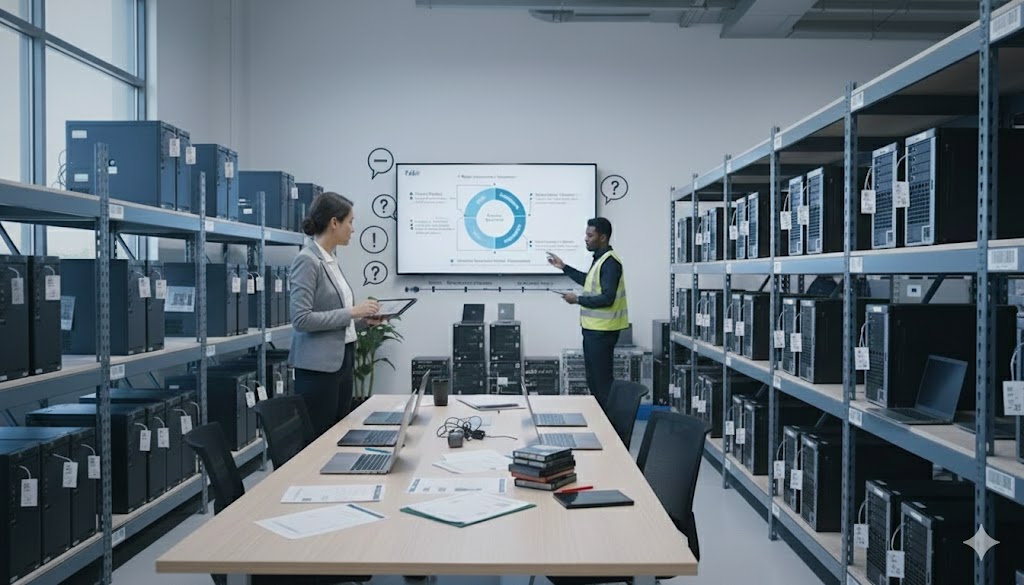
The company operates a 30,000 sq ft controlled-access, 24/7 video-monitored ITAD Megacenter with secure staging, industrial racking, dock capabilities, trained background-checked personnel, and capacity to stage and store more than 1,000,000 pounds of retired electronics and IT equipment per month.
Just as important, Integritrade publishes the actual data-destruction equipment it operates. The Integritrade equipment page identifies the Verity Datagauss ZZ001208 for approved magnetic-media degaussing, a Proton Data Security Model 104 hard-drive shredder, a SEM Model 2 SSD-VK designed to micro-shred flash media to a 2 mm particle size, and high-throughput PXE-based erasure using ADISA-verified Blancco and WipeOS platforms. The point is not that every client needs the same pathway. The point is that clients can see the equipment, understand which media it is designed for, and select a documented process that matches the project requirement. 6
Clients also receive access to TraceTech, Integritrade's client portal and ERP platform, at no additional cost. TraceTech provides real-time project and asset-status visibility after pickup, links client asset tags to Integritrade processing tags, makes available batch or individual Certificates of Erasure and Certificates of Destruction as issued, and supports client-specific handling instructions, service requests, questions, and project amendments.
A practical provider-selection checklist
Before selecting an electronics recycler or IT asset disposal provider, confirm the following:
- The recycler's R2 or e-Stewards certification is active, verifiable, and applicable to the processing facility and service scope.
- Any ISO claim identifies the exact standard, certificate scope, expiration date, certification body, and accredited certification path.
- The provider can identify the equipment and method used for HDDs, SSDs, NVMe media, USB storage, phones, tablets, and other data-bearing devices.
- The provider can explain why degaussing is appropriate for magnetic media but not flash storage.
- The provider can show how it verifies and documents sanitization or physical destruction.
- The provider can track assets, client requirements, exceptions, and final disposition through the project.
- The provider offers a defined pathway for reuse, buyback, or remarketing where equipment has value, plus qualified downstream recycling for end-of-life material.
- The provider will let the client review the facility, equipment, certificates, and documentation process before committing to a major project.
The right vendor should not ask a client to take essential claims on faith. A defensible IT asset disposal decision comes from verifiable credentials, appropriate capabilities, clear documentation, and a process that fits the actual equipment and data-risk profile.
Need a provider that can show the process?
Integritrade supports IT asset disposition, secure data destruction, corporate electronics recycling, equipment buyback, value recovery, and data-center decommissioning projects across California and throughout the Western United States.
Fresno and San Francisco Bay Area ITAD capability
Based in Fresno, Integritrade supports organizations in Fresno, Clovis, the San Francisco Bay Area, and throughout California with scheduled ITAD pickup, secure data destruction, electronics recycling, and corporate technology value-recovery projects. The 30,000 sq ft ITAD Megacenter, in-house destruction equipment, R2v3 and ISO certifications, and TraceTech client visibility platform give organizations one accountable process from collection through final disposition.
Request a free consultation or schedule a facility tour to review the equipment, documentation, and TraceTech visibility process.