Law Firm IT Asset Disposition: A Practical Guide to Legal Data Destruction and Secure Technology Recycling
Learn how law firms can plan computer disposal, legal data destruction, value recovery, and secure technology recycling with documented ITAD workflows.
Retiring legal technology is not simply an office-clearance task. A laptop awaiting replacement, a copier in a closed branch office, or an array removed during a merger may still hold information relating to client representation. The appropriate law firm IT asset disposition, or ITAD, project begins by identifying that information and deciding, asset by asset, what handling path fits the firm’s approved requirements.
The American Bar Association’s Model Rule 1.6(a) addresses information relating to the representation of a client, and Rule 1.6(c) says a lawyer shall make reasonable efforts to prevent inadvertent or unauthorized disclosure of, or unauthorized access to, that information. The accompanying comment explains that the reasonableness of safeguards depends on factors including sensitivity, likelihood of disclosure, cost, implementation difficulty, and effect on representation. [1] [2] Those principles make technology retirement a governance issue as much as a logistics issue.
This article is educational and does not provide legal advice. Each firm should have appropriate internal stakeholders, and where needed its counsel, determine records retention, preservation, client-contract, privacy, and jurisdiction-specific requirements. Integritrade does not determine a firm’s legal duties or make a firm compliant with all legal duties. Instead, its legal and professional-services ITAD program can apply the firm’s documented, client-approved handling instructions to its retired technology.
Client confidentiality should set the scope before the pickup
A useful project scope does not start with a generic instruction to “recycle computers.” It starts with the firm’s confidentiality expectations. Those expectations should shape vendor review, project scope, the records process, and the selected data-sanitization or physical-destruction method. They should also set decision owners, escalation points, asset categories, acceptance criteria, evidence required, and final disposition routes.
For a legal environment, discovery must look beyond desktop computers. A complete inventory should identify case-management and document-management systems, email archives, e-discovery collections, file servers, laptops, mobile devices, copier and multifunction-printer (MFP) drives, storage arrays, network gear, and optical or removable media. Embedded flash in firewalls, switches, printers, tablets, phones, USB devices, and M.2 modules can be easy to overlook. Record the firm asset tag, serial number where available, location, custodian, and approved path.
Before equipment leaves control, the firm can decide whether an asset or dataset is subject to preservation, retention, active-matter, client, or other restrictions. A provider should not infer those decisions from device type. A file server might hold old matters and an active collection; a network appliance may hold configuration backups; a copier may hold scanned documents. The scope should name the release authority and exception owner.
This preparation matters during a branch-office relocation, closure, or technology refresh, when equipment moves quickly and mixed assets accumulate. It also matters during a firm merger, where inventories, matter systems, and retention approaches may differ. The ABA comments recognize limited information sharing for conflicts work during changes in firm composition or ownership, while protecting information that could compromise privilege or prejudice a client. [2] Technology disposition should likewise use controlled access, minimal necessary handling, and clear instructions.
Select a documented path for each asset class
NIST SP 800-88 Rev. 2 defines media sanitization as a process that makes access to target data infeasible for a given level of effort. Its program guidance calls for techniques and controls suited to information sensitivity and intended disposition. [3] A firm can therefore approve different paths within one project. A current laptop may be a candidate for erasure and reuse, while an SSD from a high-sensitivity repository may be designated for physical destruction.
| Client-selected pathway | Appropriate planning questions | Example operational route | Project record and final route |
|---|---|---|---|
| Verified sanitization for reuse or remarketing | Is reuse permitted? Is the media eligible for the firm’s approved sanitization method? What verification evidence is required? | Inventory and custody transfer; approved PXE erasure for compatible systems; verification; functional evaluation and grading. | Asset-level result and available Certificate of Erasure; eligible equipment may move to value recovery or approved reuse. |
| Physical destruction of magnetic media | Does the firm require destruction rather than reuse? Is the device an applicable HDD or magnetic medium? | Inventory; controlled processing; HDD degauss-plus-shred method for applicable magnetic hard drives. | Serialized Certificate of Destruction; resulting material proceeds to the approved recycling stream. |
| Physical destruction of flash media | Does the device contain SSD, NVMe, phone, tablet, USB, SD, or other flash storage? | Inventory and media identification; 2 mm SSD/NVMe physical destruction for applicable solid-state and flash media. | Serialized Certificate of Destruction; processed material is routed to downstream recycling. |
| Exception and quarantine path | Did an asset fail sanitation, lack identification, or conflict with the approved instruction? | Isolate it from routine processing; record the exception; obtain the client’s authorized direction before release. | Updated asset status, exception note, and the evidence specified in the project scope. |
| Non-data-bearing end-of-life recycling | Is the item confirmed not to contain data-bearing media, or has its media been separately handled? | Inventory; segregation; approved electronics processing. | Disposition reporting and qualified downstream recycling records as applicable. |
The crucial word is selected. A firm can define the route by asset group, site, matter sensitivity, or business purpose and include it in asset instructions. The vendor executes the approved path and reports the result; it does not replace the firm’s records, security, or legal decision making.
Build chain of custody and evidence into the records process
A practical records process traces each asset from pickup through receipt, inventory, sanitization, testing, value recovery, recycling, or destruction. It should preserve the connection between the firm’s asset tag and the processor’s tracking tag. A final certificate is more useful when it traces back to the scope, manifest, custody transfer, asset identity, method, and outcome.
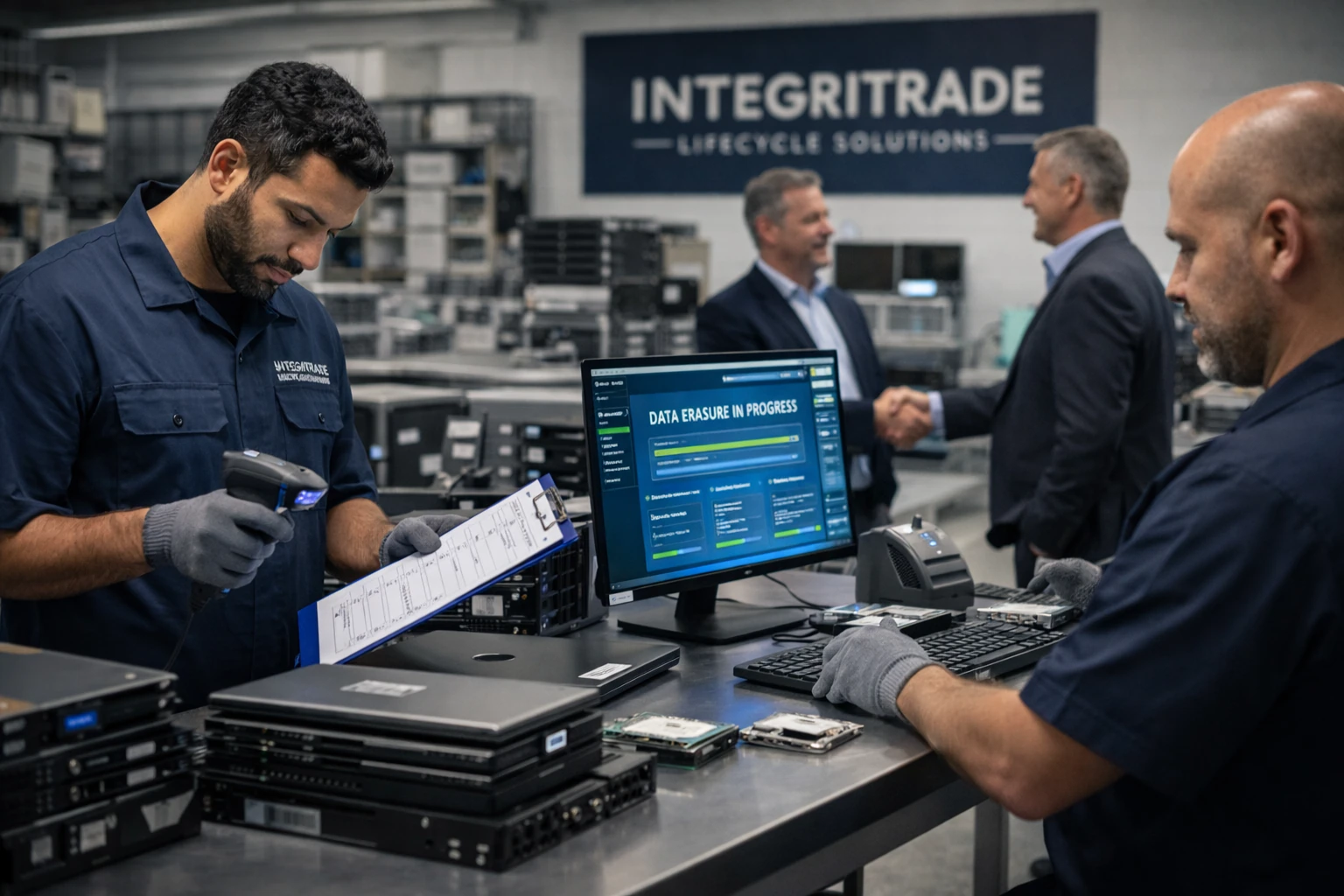
Integritrade provides TraceTech at no additional cost to its clients. The platform can connect client asset-tag reconciliation with Integritrade tracking tags and show project or asset statuses after pickup. It also makes available documentation such as chain-of-custody records, serialized Certificates of Erasure, serialized Certificates of Destruction, and project reporting, based on the agreed scope. [4] [5] Client-approved rules can be associated with the project or asset record so that the specified next step is visible when that asset is scanned.
For a multi-office project, establish pickup manifests and secure staging before removal. Have an authorized firm representative confirm handoff and reconcile quantities and exceptions promptly. For servers and arrays, document removed data-bearing components, not merely chassis counts. For MFPs, record hard-drive or embedded-storage disposition separately. For e-discovery, optical, and removable media, avoid batch descriptions that hide individual items unless the firm has approved that aggregation.
A vendor-selection checklist for law firm computer disposal
A law firm evaluating secure legal technology recycling can use the following checklist to turn expectations into verifiable questions:
- Scope controls: Can the provider accept clear, asset-level instructions for sanitation, destruction, reuse, value recovery, and exceptions?
- Custody visibility: Are pickup, manifest, receipt, inventory, and final disposition documented, with client asset-tag reconciliation?
- Media expertise: Can the provider identify HDD, SSD, NVMe, mobile, removable, optical, MFP, and embedded network-device storage instead of treating all equipment alike?
- Sanitization choices: Can the provider support the firm’s selected NIST SP 800-88 Rev. 2-aligned approach for eligible media and physical destruction when the scope calls for it? [3]
- Proof: Are Certificates of Erasure and Certificates of Destruction available at the batch or serialized asset level as agreed?
- Exception management: What happens to failed erasure, unknown equipment, mislabeled assets, or items outside the original manifest?
- Security environment: Can the provider describe controlled access, monitored processing, personnel controls, and secure staging without relying on vague assurances?
- Value recovery: How are testing, grading, pricing, revenue-share or buyback results, and the disposition of non-marketable assets documented?
- Downstream accountability: How are recycling partners and final material routes qualified and reported?
- Management systems: What independently audited certifications and scope information can the provider provide?
The vendor conversation should end with an operationally specific statement of work. “Destroy all drives” may suit one decommission, while a merger may need separate paths for retained equipment, resale candidates, and restricted media. Make those differences visible before pickup.
Value recovery and recycling should follow the data decision, not precede it
Value recovery can reduce the net cost of a technology refresh. Eligible laptops, desktops, servers, storage, network equipment, mobile devices, and accessories may retain value after approved sanitation and verification. Resale is a downstream business disposition, not a substitute for the firm’s client-data decision. The path should be “approved sanitation, verification, testing, then reuse or remarketing,” not “sell first and address data later.”
Equipment not eligible for reuse, failing the approved sanitation path, or client-designated for destruction should be separated accordingly. After approved physical destruction, materials can enter qualified downstream recycling. That sequencing distinguishes information handling from environmental processing and provides a clearer trail for finance, IT, records, security, and operations teams.
Integritrade capability for Fresno and the San Francisco Bay Area
Integritrade supports law firms and professional-service organizations in Fresno and the San Francisco Bay Area with secure pickup, tracking, and electronics recycling. Its 30,000 sq ft controlled-access, video-monitored ITAD Megacenter provides secure staging and processing capacity. Integritrade maintains R2v3, ISO 9001, ISO 14001, ISO 45001, and ISO/IEC 27001 certifications within their applicable certified scopes. [4]
Integritrade offers PXE erasure; HDD degauss-plus-shred processing for magnetic drives; and 2 mm physical destruction for SSD, NVMe, and other flash media. Its equipment and data-destruction capabilities describe these on-site methods and supported media. [6] Firms can request a free consultation to discuss asset types, pathways, documentation, and timing.
Frequently Asked Questions
References
[1] American Bar Association, Model Rule 1.6: Confidentiality of Information
[2] American Bar Association, Comment on Rule 1.6: Confidentiality of Information
[3] NIST SP 800-88 Rev. 2, Guidelines for Media Sanitization
[4] Integritrade Legal and Professional Services