Why a Reuse-Focused ITAD Provider Can Deliver More Value Than a Scrap-First Recycler
Learn why a reuse-focused ITAD provider can protect retired technology, recover more value, and manage end-of-life electronics responsibly without compromising data security.
When a company retires technology, it faces a deceptively simple question: Is this equipment an asset, or is it scrap?
The wrong answer can leave money on the table, shorten the useful life of functioning technology, and create unnecessary security concerns. A reuse-focused IT asset disposition provider starts with a different question: What is the best approved outcome for this equipment after its data has been handled correctly?
That is an important distinction. A materials recovery facility plays a necessary role in the lifecycle of electronics. Truly end-of-life equipment needs responsible downstream recycling. But a scrap-first process is not always the best first step for corporate laptops, servers, storage, networking equipment, mobile devices, GPUs, adapters, displays, and components that may still have reuse or resale value.
The U.S. Environmental Protection Agency describes sustainable electronics management as a lifecycle approach that includes reducing materials used, increasing reuse, refurbishing, extending product life, and recycling. EPA also notes that reuse and refurbishing extend product life spans and contribute to source reduction. [1]
The junkyard analogy: the buyer’s business model affects what they see
Imagine selling a working car to a junkyard. The junkyard may pay for its weight, its metal, and perhaps a few immediately obvious parts. That is not because the yard is necessarily doing anything wrong. It is because its business is built around dismantling and material recovery.
Now imagine taking the same car to a dealer, a repair shop, or a specialty buyer. They may look at the engine, mileage, condition, title, serviceability, market demand, and resale potential. They see different opportunities because they have different processes, buyers, and incentives.
Retired corporate IT works the same way.
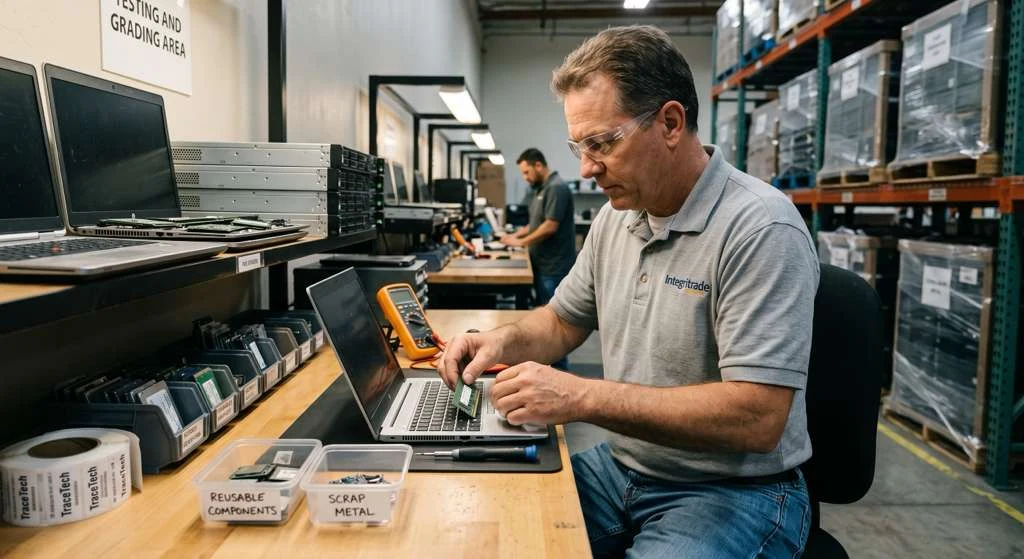
A scrap-first provider may look at a pallet of laptops as pounds of mixed e-scrap. A reuse-focused ITAD provider looks for working systems, usable configurations, server components, memory, processors, SSDs, GPUs, network cards, displays, docks, chargers, rails, adapters, remotes, and other items that can contribute to a higher-value outcome. That does not mean every asset will qualify for resale. It means the evaluation happens before the equipment is irreversibly reduced to scrap.
Reuse-first does not mean security second
A common misconception is that value recovery creates additional data risk. It should not.
The real question is whether the provider has the facility, equipment, workflow, and documentation to perform data handling before a device is routed to reuse, remarketing, donation, direct buyback, or parts recovery. NIST SP 800-88 Rev. 2 defines media sanitization as rendering access to target data infeasible for a given level of effort and describes the need for proper, applicable techniques and controls based on information sensitivity and media type. [2]
A well-designed reuse-focused process follows this order:
| Step | What happens | Why it matters |
|---|---|---|
| 1. Identify | The asset, storage media, client tag, and project requirements are identified. | Devices may contain more than one data-bearing component, and not all storage is obvious at first glance. |
| 2. Apply approved data requirements | The client’s selected method is applied, such as NIST SP 800-88 Rev. 2-aligned Clear or Purge, another organization-required protocol when appropriate, or physical destruction. | Security requirements should drive the disposition decision, not the other way around. |
| 3. Verify and document | Successful sanitization is verified and a serialized Certificate of Erasure or Certificate of Destruction is issued for the applicable service. | The project has a traceable record of the work performed. |
| 4. Test and grade | Eligible equipment is tested and evaluated for functional and cosmetic condition. | The real reuse or resale opportunity becomes visible only after approved data handling and testing. |
| 5. Recover value or recycle | Equipment is directed to redeployment, direct buyback, revenue-share remarketing, donation, parts harvesting, or qualified downstream recycling. | The client gets the best approved outcome for the asset, rather than a default scrap decision. |
This is not a slower or weaker version of security. It is a more deliberate process that recognizes that secure erasure can preserve value when the client’s requirements permit reuse. If erasure fails, the device is locked, media is damaged, or the client requires destruction, the asset can be routed to the approved physical-destruction pathway instead.
Where value is commonly overlooked
The most valuable items are not always the most obvious ones. A reuse-focused ITAD program evaluates the whole equipment mix rather than just the most recognizable devices.
| Asset category | Commonly overlooked value opportunity |
|---|---|
| Corporate laptops and desktops | Current-generation configuration, memory, storage, charger, dock, cosmetic grade, and functional condition can affect resale potential. |
| MacBooks, tablets, and mobile fleets | Condition, model, storage capacity, accessories, management-lock readiness, and successful data handling can affect eligibility. |
| Servers and storage | Processors, memory, storage drives, RAID controllers, NICs, rail kits, power supplies, and compatible components may have recovery value. |
| Networking equipment | Switches, firewalls, wireless equipment, modules, power supplies, optics, and accessories may be reusable or marketable. |
| GPUs and specialty cards | Graphics cards, accelerators, capture cards, and specialty components can retain value if they are correctly identified and tested. |
| Accessories and components | OEM power adapters, docks, monitors, remotes, stands, cables, boards, and replacement parts can contribute to the overall recovery result. |
| Devices that fail resale testing | A failed whole unit may still produce tested reusable components before the remaining material is recycled. |
That last point is important. “Not resale-ready” does not necessarily mean “worthless.” A laptop that fails testing may still have reusable memory, a display, a keyboard, an adapter, a drive, or other components. The right next step is a cost-benefit decision based on labor input, condition, safety, data requirements, and the expected recovery outcome.
Recycling remains essential - but it should be the right final step
A reuse-focused ITAD provider is not anti-recycling. Responsible downstream recycling is essential for equipment that is damaged, obsolete, nonfunctional, not approved for reuse, or no longer economical to repair or harvest.
EPA explains that electronics recycling can recover valuable materials, including metals and other commodities, for return to the supply chain. It also notes that responsible electronics management can reduce pollution, conserve resources, and reduce the energy associated with manufacturing from virgin materials. [1]
The difference is sequencing. A value-first workflow should consider the following order when the client’s requirements allow it:
Reuse or redeployment → Direct buyback or remarketing → Parts harvesting → Qualified downstream recycling
Recycling is not a failure. It is the appropriate destination for truly end-of-life material. The missed opportunity occurs when a provider skips the evaluation and sends usable assets directly into a lower-value materials stream.
What this means for a business IT refresh
For an IT department, a lifecycle decision should not be reduced to “haul it away.” A technology refresh can involve a mix of high-value equipment, low-value equipment, data-bearing media, legacy peripherals, accessories, damaged units, equipment that must be destroyed, and equipment that may produce a return.
A reuse-focused ITAD provider can help divide that inventory into the right paths while keeping the project secure and documented. That may include:
- Direct buyback for eligible equipment where the client prefers a faster, quoted transaction.
- Revenue-share remarketing for clients willing to wait for potential resale proceeds.
- Reuse or redeployment evaluation for equipment that can remain in productive use.
- Parts harvesting for systems that fail whole-unit testing but contain viable components.
- Physical data destruction for devices or media that require it.
- Qualified downstream recycling for material that is truly at end of life.
The result is not simply a cleaner warehouse. It is a more controlled IT asset disposition program that addresses security, value, sustainability, and documentation together.
Why Integritrade is built for a value-first process
Integritrade is based in Fresno, California and supports ITAD, data destruction, electronics recycling, asset recovery, corporate equipment buyback, and remarketing projects across California and the Western United States.
Integritrade operates from a dedicated 30,000 sq ft controlled-access, 24/7 video-monitored ITAD facility with secure staging, industrial pallet racking, dock access, and pallet-handling capability. The facility can securely stage and store more than 1 million pounds of retired IT equipment and electronics each month, supporting corporate refreshes, multi-site collections, data-center projects, returns processing, and large mixed-equipment programs.
The company is R2v3 certified and maintains ISO 9001, ISO 14001, ISO 45001, and ISO 27001 certifications. Background-checked personnel use documented workflows to evaluate equipment for reuse potential, perform approved data sanitization or physical destruction, test and grade eligible assets, recover usable components, and route non-recoverable material to qualified downstream recycling.
Integritrade’s on-site capabilities include PXE-based data erasure, 2 mm shredding for SSD and NVMe media, and degauss-plus-shred processing for applicable magnetic hard drives. When erasure is the approved option and is successfully completed, the process generates a serialized Certificate of Erasure that supports a reuse pathway. Physical-destruction services can generate serialized Certificates of Destruction, with photographed, recorded, live-streamed, or witnessed-destruction options available based on project scope.
The proprietary TraceTech client platform is included at no additional cost for Integritrade clients. Authorized users can follow project and asset status after pickup, reconcile client tags with Integritrade tracking tags, manage service requests, retrieve available documentation, review estimated CO2e reporting by documented disposition pathway, and see applicable buyback or revenue-share information. TraceTech can also surface client-approved requirements when assets are scanned, helping keep the selected workflow visible throughout processing.
Do not choose between recovery and responsibility
A company should not have to choose between better recovery and responsible handling. It should expect both.
The right ITAD provider looks at the entire lifecycle of the equipment, not just the pallet’s scrap weight. It asks what data is on the asset, what the client requires, whether reuse is allowed, what the device or component can recover, and how the final outcome will be documented.
That is the difference between sending a car to a junkyard and taking it to a buyer who understands the car. Both paths may be appropriate in the right situation. But before writing off a corporate IT fleet as scrap, a business should work with a provider that knows how to recognize value, protect data, and manage the assets that truly have reached end of life.